I stand corrected. About the cost of bicycles, at least.
When I began this blog, I intended to write about inexpensive consumer products through the lens of a disposable razor that I intended to use as long as I could. Among other topics, I wrote about the seeming expense of a new bike. While many consumer products (watches, for example) offer superb quality at low cost, bikes still seem expensive. In short, while a $5 digital watch keeps time as well as a $5,000 Rolex, the $149 bike you buy at Wal-Mart stinks.
Turns out that I was looking at the wrong end of the telescope. Bikes have gotten a lot cheaper, just not in my lifetime.
According to economic inequality superstar Thomas Piketty, bikes cost one-fortieth of what they used to (see pages 88-89 of "Capital in the 21st Century"). In the 1880s, a new bike cost the equivalent of six month's of a typical worker's salary. Today, it costs less than a week's wages.
I still hold out hope for some breakthrough material, design or process that cuts the cost of a good bike. I suspect that someone will find a replacement for the spoked wheel, which has a high labor cost. Or, perhaps, someone will find a way to manufacture a frame in one piece.
Maybe Piketty's elites bought up the patents for these kinds of innovations to prevent the proletariat from pedaling to the barricades.
Wednesday, June 18, 2014

Monday, May 19, 2014
Cheap bike gear that fits like a glove
True Grip General Purpose Gloves: Cheap Biking Gloves


- Replaces: Traditional full-finger bike gloves such as these from Performance Bike.
- Cost differential: 2x-4x.
- Available: I bought mine at Home Despot for $10. They don't seem to appear on the website, however.
- Why I like it: When riding my bike in the city, I've always preferred full-finger bike gloves because you never know what you're going to have to grab or push yourself away from. Usually buses, but sometimes...other things.
Bike stores and websites such as Performance and Nashbar will happily sell you bike gloves with full fingers for $20 (at best) or more. I've bought several pairs from them that range from good to lousy. Since I almost always buy from catalogs, I never get a chance to try them on beforehand.
I already stash a pair of mechanic's gloves in my camera bag to use in cold weather. The ones I use have reinforced palms. It occurred to me that someone must make something similar with padded palms, useful for absorbing handlebar shock. Indeed, Home Depot had the True Grip brand and they fit the bill. In addition to the cheap price, I appreciated the ability to try them on and find the right fit.
Some tips: - If you shop at Home Depot or Lowe's, look around. While HD had name-brand Mechanix gloves front-and-center, I found these cheaper gloves in the locksmith department.
- In addition to padding on the palm, you probably also want padding on the thumb and some terrycloth on the back to wipe sweat away.
- I haven't used these in really hot weather yet, so I can't tell you whether the backs, which seem thicker than those on true cycling gloves, will be an issue.
Monday, July 29, 2013
Widgy Pry Bar
Widgy Pry Bar: Indispensable Keychain Tool

As always, what cheap products do you know that are worth buying? Please share!

- Replaces: Ye olde trusty Swiss Army Knife.
- Cost differential: 2x. And up, depending on how many tools your SAK has.
- Available: The always-entertaining CountyComm.com sells these small crowbars as well as a host of other useful tools, flashlights and pocket knives
- Why I like it: I have maximalist tendencies. On any given day, I have a bottle opener, multi-head screwdriver, USB flash drive and one of these Widgy Bars (the Micro model) on my keychain. And a flashlight. And that doesn't count the other tools (SAK, another flashlight) that I generally have in my other pocket. Why do I have all this metal on me? Search me. I think I carry them more as talismans against non-specific evil than anything else.
But enough about me.
Of all the stuff I carry, the Widgy Bar gets pulled out the most because it does the most. CountyComm designed these as nail pullers and as mini-prybars. You'd be surprised how often you might need to remove a staple or pry something apart (recently, I needed mine several times to open up some hooks used to secure a party tent; true story).
But wait, folks, there's more. With a sharp-ish edge, these tools will also open most packages. In a pinch, the edge also works as a flathead screwdriver, albeit not the most handy one given the curved end.
Naturally, a Swiss Army Knife does all these things and more. However:
- Most SAKs don't work well with keychains, meaning you have a greater propensity to lose them.
- I've never had a problem getting my Widgy Bar through airport security, and if I did, it would cost me $10 to replace it (I could swear I bought mine a few years ago for $5, but I may be incorrect).
Suffice it to say that if I only had room on my keychain for one tool, this would be it.
As always, what cheap products do you know that are worth buying? Please share!
Sunday, June 30, 2013
I spoke too soon
Two weeks ago, I recommended a cheap watch, the Casio F-105. Perhaps I shouldn't have.

Here's a closeup under a brighter light

In case you can't see it too clearly, some water got inside my watch. That should not have happened, as I was only swimming in a pool and I doubt my wrist got more than three feet under water.
That said, the thing still works fine and, in my experience, the water will eventually evaporate. However, it hasn't lived up to its 100-meter water resistance rating. I'm a little disappointed.
I'll give you a heads up if I find a better watch at the under $20 price level.

Here's a closeup under a brighter light

In case you can't see it too clearly, some water got inside my watch. That should not have happened, as I was only swimming in a pool and I doubt my wrist got more than three feet under water.
That said, the thing still works fine and, in my experience, the water will eventually evaporate. However, it hasn't lived up to its 100-meter water resistance rating. I'm a little disappointed.
I'll give you a heads up if I find a better watch at the under $20 price level.
Friday, June 21, 2013
Uncle Sam wants YOU...to have a good, cheap sun hat (helloooo summer!)
U.S. Military Boonie Hats

As always, what cheap products do you know that are worth buying? Please share!

- Replaces: That baseball cap that's not giving you any real UV protection.
- Cost differential: 2x. 7x when compared to Tilley hats.
- Available: Check your local army-navy store. Some camping stores, including New York's venerable Tent & Trails carry them, too. Of course you can buy them online, for prices under $10, but I'm not savvy enough about the differences between genuine military surplus and knock-offs to know whether you're really getting the best deal. I've never paid more than $20 for one.
- Why I like it: I like the beach, where sunlight reflects every which way. I have almost no hair on my head. As a result, if I don't wear a good hat, my head starts to look like a lumpy tomato. Any broad-brimmed hat will do the job, so why pay for space-age materials or dubious claims of added sun protection? The military spent a lot of time designing this hat. No need to improve on it much.
If you've never worn a proper sun hat before, you might not know that they actually help you keep a little cooler by keeping the sun off your face and neck. Also, this model, which has grommets on the side, lets a little air inside. In fact, the very top of the hat has a thinner layer of fabric than the rest of the crown, which lets a little heat escape.
Of course, the military look may turn some people off. What can I say? Get it in a neutral color like khaki or some weird camo pattern. Or dye it. Or stick pinko political buttons in the cartridge loops. I used to wear mine with my "Hillary for President" t-shirt to drive people nuts.
As always, what cheap products do you know that are worth buying? Please share!
Tuesday, June 11, 2013
Cheap watch that takes a beating
Casio F-105 Watch


As always, what cheap products do you know that are worth buying? Please share!
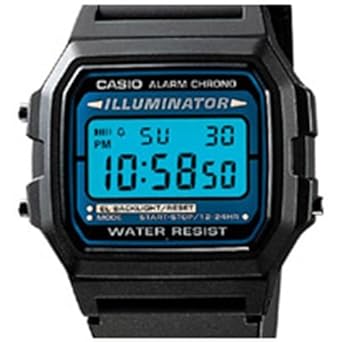
- Replaces: Pretty much any watch you'd need to wear 95% of the time.
- Cost differential: 2x. And up, depending on what you wear on your wrist.
- Available: You can usually find this watch, or something similar, at any mass merchandiser. If you're an Amazon.com shopper, you might even find it for under $10 bucks (I did), cheap enough to be a throw-in if you're the type who lumps purchases together for free shipping.
- Why I like it: I've written before about this watch, but let me expand on it for a moment. This watch has nearly every function you could reasonably expect--and actually use--from a watch. It keeps quartz-accurate time, it has an alarm, a stopwatch feature and a pretty bright light. It features a water resistance to 100 meters. For you non-watch geeks out there, 100 meter water resistance means that it's good for every kind of water activity except SCUBA diving.
What can't it do? Obviously, not SCUBA. It doesn't have a countdown timer or bezel (which dive watches do), a surprisingly useful feature if you deal with time limitations such as parking meters or food in the oven. While the nightlight works well, an analog watch with glow-in-the-dark hands seems more handy to me. However, I can live with it.
You could argue that you can't wear it on dressy occasions, but I really don't care that much. Jeez, the President of the United States used to wear a Timex digital watch. Get over it.

Yeah, that's the 42nd President of the United States.
If he can greet Nelson Mandela with an Ironman watch,
you can wear a cheap Casio to a client meeting.
If he can greet Nelson Mandela with an Ironman watch,
you can wear a cheap Casio to a client meeting.
- Truthfully, lots of digital watches could do the job of this little Casio. I don't have much experience with other brands, but I have never had any complaints about Casio. For instance, they sell a similar model called the F-91W, which I've seen for well under $10 (not today, though). Aside from its sinister reputation, it's pretty much the same thing as the F-105, but with a 50M water resistance rating. It's probably suitable for pool use and it's cheap enough that you could simply buy a new one if it did leak. Nevertheless, I like the added assurance of the 100 M rating.
Your mileage may vary, of course.
As always, what cheap products do you know that are worth buying? Please share!
Tuesday, June 4, 2013
A New Direction
So after writing pretty random things on this blog for the past two months, I've finally figured out what I want to discuss on the Cheap Razor Experiment blog: cheap stuff actually worth buying.
I'll update it when I have a new product to write about. Better yet, I'd like my readers (both of you) to contribute ideas for products to write about.
Here's the brief: we'll discuss products that punch above their weight.
By that definition, I mean products that do the work of something that costs a multiple (let's start with 2x) as much either nearly or entirely as well. Obviously, this category has fuzzy, very subjective boundaries. I hate to quote Potter Stewart, but I think I'll know it when I see it.
What I'm not looking for is "best in class" or "as good as the best but 20% cheaper." If it isn't a great product at a substantially cheaper price, I'm not interested. Play the Kinks' song "Low Budget" over and over again until you get it.
God knows we all buy cheap stuff now and again. However, these cheap things sometimes turn out to cost more than a more expensive product--you may need to buy twice or pay good money for something you only use once. I'll try to avoid those products as well.
I owe a debt of gratitude to two sites for this idea. Kevin Kelly's Cool Tools site uses reviews from consumers of products they like. In fact, you can't get their newsletter without submitting a review. Also, Lifehacker frequently features good, inexpensive products. I'll try to stray away from Cool Tools' tendency to highlight very specialized tools. Similarly, I'll avoid Lifehacker's MacGyver tendencies. However, I can't say that I won't tread paths they've already cleared from time to time.
I'll try to hew to a consistent format for the blog, including fields for:

I'll update it when I have a new product to write about. Better yet, I'd like my readers (both of you) to contribute ideas for products to write about.
Here's the brief: we'll discuss products that punch above their weight.
By that definition, I mean products that do the work of something that costs a multiple (let's start with 2x) as much either nearly or entirely as well. Obviously, this category has fuzzy, very subjective boundaries. I hate to quote Potter Stewart, but I think I'll know it when I see it.
What I'm not looking for is "best in class" or "as good as the best but 20% cheaper." If it isn't a great product at a substantially cheaper price, I'm not interested. Play the Kinks' song "Low Budget" over and over again until you get it.
God knows we all buy cheap stuff now and again. However, these cheap things sometimes turn out to cost more than a more expensive product--you may need to buy twice or pay good money for something you only use once. I'll try to avoid those products as well.
I owe a debt of gratitude to two sites for this idea. Kevin Kelly's Cool Tools site uses reviews from consumers of products they like. In fact, you can't get their newsletter without submitting a review. Also, Lifehacker frequently features good, inexpensive products. I'll try to stray away from Cool Tools' tendency to highlight very specialized tools. Similarly, I'll avoid Lifehacker's MacGyver tendencies. However, I can't say that I won't tread paths they've already cleared from time to time.
I'll try to hew to a consistent format for the blog, including fields for:
- What it replaces
- Cost differential
- Where you can buy it (if it's not a mass-market item)
- Why I (or if you want to write, you) like it/brief review
Feel free to email me or leave a comment if you want to suggest a product or write something yourself. I'm happy to share credit.
Owing to the original purpose of this blog, I'd like to start with:
Schick Quattro Disposable Razor

- Replaces: Pretty much every other razor you can buy, but only if you use the simplest trick in the world. After shaving, rinse the blade and wipe it dry on your towel. That's it.
- Cost differential: 5x vs. Gillette or Schick cartridge razors. And up.
- Available: pretty much everywhere. Amazon has it for what amount to less than $2 per razor.
- Why I like it: As I said, if you rinse and dry your razor, you can use this blade for a long, long time. I'm approaching 30 shaves over 2 months and haven't noticed any harshness. In truth, the rinse/dry trick works with any multiblade razor. However, I've noticed that after a few weeks, the head of a cartridge razor such as the Gillette Mach 3 will simply keep popping off. The one-piece disposable doesn't have that problem.
Considering that Amazon sells the Fusion for just under $10, disposables might actually make a lot of sense...as long as you don't actually dispose of them. The value equation gets radical when you realize that you'll have to replace the cartridges on a Fusion more often than you'll need to buy a new disposable.
I should say that I haven't tested every kind of razor, but I have been shaving for 25 years or so, so I feel I know what works. Would a Gillette disposable work just as well? Probably. Does the Fusion have the same weak joint problem as the Mach 3? Don't know, but I don't see how it would help Gillette/P&G to fix that problem.
If you have a different experience with razors, please share. Also, as I said, I'm happy to take suggestions or reviews from others. Let me know!
Wednesday, May 29, 2013
Shave #27: When you can't pay for quality
Another shave, another nearly-faultless performance by Mssrs. Quattro and Barbasol. I still find the Barbasol less smooth than modern gels, but I'll use it until I run out.
I've discussed paying for quality several times in this blog, but so far, I haven't talked about when you can't pay for quality. What I mean is, because of the dynamics of the marketplace, sometimes you can only choose cheap.
Let me give you an example. The bench I put my TV on cost about $50 at IKEA (no IKEA hate, please; I'll probably address them sooner or later). It assembled easily, looks pretty good and has help up admirably under the assault of my children for about seven years. And I didn't want it.
When I went shopping for a bench, I wanted simple looks with solid construction. IKEA and Target offered attractive options made of particle board for well under $75. I wanted solid wood since I've found that particle board varies widely in quality. My only options for similar units made of solid wood came from places like Crate & Barrel and the laughably-named Design Within Reach for $750.
Simply put, I couldn't find anything between an order of magnitude. When it came down to it, my only option was cheap, since I wasn't going to shell out $750 for a table to hold my TV.
I've found other product categories that seem to have a high and low, but no middle. Men's dress shoes, for instance, have $99 specials and $350 (and up. Way up.) models, with few options in between. Briefcases as well seem to have a gulf between canvas, nylon and cheap leather models and the real deal.
I suspect this dynamic has evolved because manufacturers can always find a high-margin luxury market and/or a high-volume economy market but they can't always find a mid-level market. And, to be fair, the particle board bench has held up as well as I would have expected solid wood to hold up. Nevertheless, you'd think someone would seize on this opportunity already.
Maybe I'll start a line of $25 razors and see who bites.
I've discussed paying for quality several times in this blog, but so far, I haven't talked about when you can't pay for quality. What I mean is, because of the dynamics of the marketplace, sometimes you can only choose cheap.
Let me give you an example. The bench I put my TV on cost about $50 at IKEA (no IKEA hate, please; I'll probably address them sooner or later). It assembled easily, looks pretty good and has help up admirably under the assault of my children for about seven years. And I didn't want it.
When I went shopping for a bench, I wanted simple looks with solid construction. IKEA and Target offered attractive options made of particle board for well under $75. I wanted solid wood since I've found that particle board varies widely in quality. My only options for similar units made of solid wood came from places like Crate & Barrel and the laughably-named Design Within Reach for $750.
Simply put, I couldn't find anything between an order of magnitude. When it came down to it, my only option was cheap, since I wasn't going to shell out $750 for a table to hold my TV.
I've found other product categories that seem to have a high and low, but no middle. Men's dress shoes, for instance, have $99 specials and $350 (and up. Way up.) models, with few options in between. Briefcases as well seem to have a gulf between canvas, nylon and cheap leather models and the real deal.
I suspect this dynamic has evolved because manufacturers can always find a high-margin luxury market and/or a high-volume economy market but they can't always find a mid-level market. And, to be fair, the particle board bench has held up as well as I would have expected solid wood to hold up. Nevertheless, you'd think someone would seize on this opportunity already.
Maybe I'll start a line of $25 razors and see who bites.
Monday, May 27, 2013
Shave #26: Food and Tools
Another Monday shave, another flawless performance by the Schick Quattro disposable. I'm also getting used to the less-smooth shave afforded by an old can of Barbasol.
Throughout this experiment, I've challenged myself to think about what else I could go cheap on. As in, when something I own wears out, or when I need something I don't have, what can I buy the Schick Quattro version of and what should I shell out good money for?
I've learned by considerable trial-and-error that food, as a rule, has a distinct you-get-what-you-pay-for quality to it. In particular, the less processing a food has, the more quality costs.
For instance, steak. When I cooked for myself alone, I used to treat myself to a broiled steak on Sundays. At first, I bought cheap bottom round from A&P and I generally liked the result. Then, after I had made a little more money, I tried better cuts of meat. Meat connoisseurs already know what happened; I couldn't go back to the cheaper cuts.
Same thing happened with coffee. While I consider myself capable of drinking anything hot and black, I probably rank somewhere midway up the coffee snob scale. With the exception of my beloved Zabar's, I can't find inexpensive coffee that's anywhere near good enough for me. Of course, I live near Zabar's, so it's not an issue.
Food quickly descends into a chaos of warring attitudes. Some would consider the cuts of meat I like to be middlebrow at best. Others would turn their noses up at anything but organic meats. And, of course, many would disagree with meat entirely. However, I've found a pretty comfortable balance with price and quality with food.
I can't say the same for tools, unfortunately.
I use basic hand tools--screwdrivers, hammers, pliers and the like--frequently enough. In a home with two very destructive kids, something needs reassembling, new batteries or some other minor repair at least once per week. So I have the toolbox down all the time.
That said, I can't get too excited about really high-quality tools. My basic toolset generally features American-made tools that cost more than the basic Chinese-made tools. However, I have a second tool kit filled almost exclusively with Chinese tools. My electric screwdriver has a Japanese name and a Made in China stamp on it. My ratchets all come from China as well.
And you know what? They work as well as they need to work. These more specialized tools don't come out too often and I haven't had an issue yet.
Maybe I'll prove out "buy cheap, buy twice" yet. However, when I do, I probably won't remember when I bought them in the first place.
Throughout this experiment, I've challenged myself to think about what else I could go cheap on. As in, when something I own wears out, or when I need something I don't have, what can I buy the Schick Quattro version of and what should I shell out good money for?
I've learned by considerable trial-and-error that food, as a rule, has a distinct you-get-what-you-pay-for quality to it. In particular, the less processing a food has, the more quality costs.
For instance, steak. When I cooked for myself alone, I used to treat myself to a broiled steak on Sundays. At first, I bought cheap bottom round from A&P and I generally liked the result. Then, after I had made a little more money, I tried better cuts of meat. Meat connoisseurs already know what happened; I couldn't go back to the cheaper cuts.
Same thing happened with coffee. While I consider myself capable of drinking anything hot and black, I probably rank somewhere midway up the coffee snob scale. With the exception of my beloved Zabar's, I can't find inexpensive coffee that's anywhere near good enough for me. Of course, I live near Zabar's, so it's not an issue.
Food quickly descends into a chaos of warring attitudes. Some would consider the cuts of meat I like to be middlebrow at best. Others would turn their noses up at anything but organic meats. And, of course, many would disagree with meat entirely. However, I've found a pretty comfortable balance with price and quality with food.
I can't say the same for tools, unfortunately.
I use basic hand tools--screwdrivers, hammers, pliers and the like--frequently enough. In a home with two very destructive kids, something needs reassembling, new batteries or some other minor repair at least once per week. So I have the toolbox down all the time.
That said, I can't get too excited about really high-quality tools. My basic toolset generally features American-made tools that cost more than the basic Chinese-made tools. However, I have a second tool kit filled almost exclusively with Chinese tools. My electric screwdriver has a Japanese name and a Made in China stamp on it. My ratchets all come from China as well.
And you know what? They work as well as they need to work. These more specialized tools don't come out too often and I haven't had an issue yet.
Maybe I'll prove out "buy cheap, buy twice" yet. However, when I do, I probably won't remember when I bought them in the first place.
Wednesday, May 22, 2013
Shave #24: Back to the 20th Century
In my ongoing quest to see how cheap I can make the shaving experience, I tried something new today. Or, rather, something old:

Yes, Barbasol. OK, so I used the version in the can. I even used the Soothing Aloe version with the green barber pole stripe. Call it a concession to modernity.
Actually, call it a concession to availability. Last year, my son's teacher assigned him a spelling exercise where he had to write out words in shaving cream sprayed on a plate. It didn't make any sense then, either.
However, rather than sacrifice my usual Edge Gel or Gillette Fusion Shave Gel, (whatever Costco has when I need to re-stock), I bought a cheap can of shaving cream. Before that, I hadn't used Barbasol since college, when I selected the brand based on a rational analysis of whatever was cheapest.
To my surprise, it worked pretty well. My cheapo Quattro felt less smooth when I dragged it across my face, but the shave ended up just as close. Of course, the proof may require a few more shaves to see if any irritation creeps up.
Can you possibly stand the suspense?

Yes, Barbasol. OK, so I used the version in the can. I even used the Soothing Aloe version with the green barber pole stripe. Call it a concession to modernity.
Actually, call it a concession to availability. Last year, my son's teacher assigned him a spelling exercise where he had to write out words in shaving cream sprayed on a plate. It didn't make any sense then, either.
However, rather than sacrifice my usual Edge Gel or Gillette Fusion Shave Gel, (whatever Costco has when I need to re-stock), I bought a cheap can of shaving cream. Before that, I hadn't used Barbasol since college, when I selected the brand based on a rational analysis of whatever was cheapest.
To my surprise, it worked pretty well. My cheapo Quattro felt less smooth when I dragged it across my face, but the shave ended up just as close. Of course, the proof may require a few more shaves to see if any irritation creeps up.
Can you possibly stand the suspense?
Monday, May 20, 2013
Shave #23: Mr. Coffee
As the sufficiency of the Schick Quattro continues to manifest itself, I have thought about other things that I could replace with cheaper alternatives. However, as John Lennon, or perhaps someone else, said: "life is what happens to you while you're busy making other plans."
Hence my new cheap alternative: a Black & Decker 12-cup coffee maker. Previously, I had owned and enjoyed a much fancier Krups coffee maker of the same capacity. However, the Krups did not like its storage spot underneath the kitchen counter (a necessity given our small apartment kitchen). OK, I dropped it several times, chipping away at the plastic exterior and eventually shattering the carafe.
I had spent about $50 on the Krups and didn't want to spend a lot of money on a replacement (long story short, we're moving in a few months and if we have adequate counter space in the new apartment, I had planned to treat myself to a big-boy coffee maker). Thus, I opted to spend $30 on a new coffee maker.
The results? Pretty good.
Of course, I use good coffee, since I have learned from extensive testing that cheap coffee sucks. That said, good coffee doesn't cost that much more. Zabar's sells several roasts at $7.98 per pound (yes, I see the links for $9.98 per pound; it costs less in the store). After tinkering with the ratio of grounds to water, I found that the cheap coffee maker worked as well as the more expensive one.
Naturally, time will tell. Durability or longevity often mark true quality. So maybe the coffee maker will fall apart in a few weeks. Until then, however, I'll keep looking for the discount rack alternatives.
Hence my new cheap alternative: a Black & Decker 12-cup coffee maker. Previously, I had owned and enjoyed a much fancier Krups coffee maker of the same capacity. However, the Krups did not like its storage spot underneath the kitchen counter (a necessity given our small apartment kitchen). OK, I dropped it several times, chipping away at the plastic exterior and eventually shattering the carafe.
I had spent about $50 on the Krups and didn't want to spend a lot of money on a replacement (long story short, we're moving in a few months and if we have adequate counter space in the new apartment, I had planned to treat myself to a big-boy coffee maker). Thus, I opted to spend $30 on a new coffee maker.
The results? Pretty good.
Of course, I use good coffee, since I have learned from extensive testing that cheap coffee sucks. That said, good coffee doesn't cost that much more. Zabar's sells several roasts at $7.98 per pound (yes, I see the links for $9.98 per pound; it costs less in the store). After tinkering with the ratio of grounds to water, I found that the cheap coffee maker worked as well as the more expensive one.
Naturally, time will tell. Durability or longevity often mark true quality. So maybe the coffee maker will fall apart in a few weeks. Until then, however, I'll keep looking for the discount rack alternatives.
Wednesday, May 15, 2013
Shave #21: I'm kind of in awe
Honestly, I never expected my cheap razor experiment to last this long. I thought the Schick Quattro disposable would have given out by now. However, twenty-one shaves in, I'm still getting a clean, reasonably smooth shave.
I hate to sound like a commercial. Moreover, I suspect that Schick would rather I experience the need to buy more razors. However, I have to admit a kind of awe at how well this thing works.
Gotta think of some torture tests, because this is getting boring.
I hate to sound like a commercial. Moreover, I suspect that Schick would rather I experience the need to buy more razors. However, I have to admit a kind of awe at how well this thing works.
Gotta think of some torture tests, because this is getting boring.
Monday, May 6, 2013
Shave #17: This is a MANLY Razor
Now that I've put a whole month into the Cheap Razor Project, I feel pretty good about the results (another smooth Monday morning shave today), good enough to question my manhood.
One of my favorite sites, Lifehacker, posted a video from Art of Manliness about how a real man shaves, with a safety razor, as his grandfather did.
This emphasis reminds me of only one thing, a John Belushi Saturday Night Live sketch rather obsessed with manliness in a very different way. Of course, I can't find it on Hulu, so read the transcript here.
I don't cast aspersions on any man's or any woman's vision of masculinity. That said, what kind of man needs to spend $57.99 (the cheapest pricing for the items mentioned in the article) to shave when a $2 disposable and any mass-market foam or gel seems to serve so admirably?
One of my favorite sites, Lifehacker, posted a video from Art of Manliness about how a real man shaves, with a safety razor, as his grandfather did.
This emphasis reminds me of only one thing, a John Belushi Saturday Night Live sketch rather obsessed with manliness in a very different way. Of course, I can't find it on Hulu, so read the transcript here.
I don't cast aspersions on any man's or any woman's vision of masculinity. That said, what kind of man needs to spend $57.99 (the cheapest pricing for the items mentioned in the article) to shave when a $2 disposable and any mass-market foam or gel seems to serve so admirably?
Joe Jackson makes a good point
Perhaps I'm missing out on something great. And perhaps I shouldn't knock it until I've tried it. I just can't imagine having more shaving stuff in the bathroom than my wife has for her hair. Of course, that's more a statement of how small our bathroom is than my perceptions of masculinity.
My own two grandfathers, so happens, had radically different approaches to shaving.
My maternal grandfather, Ray, liked to treat himself. Recently, my dad gave me one of his old razors, which had some sort of bone or horn handle and took Trac II blades. He certainly would have availed himself of Gillette's or Schick's finest had he lived until today.
According to my father, my paternal grandfather, Sam, immigrated to the U.S. from Ukraine at the age of 12 and maintained an immigrant's sensibility all his life. He would collect the little bits of soap left over in the shower and mix them up in a shaving mug. While that seems like a nod towards ye olde double-edge, I like to think he'd smile at my attempt to wring every penny out of a $2 razor.
Of course, there's an old Irish proverb I learned from the back of a sugar packet once, "a man's got to do his own growing, no matter how tall his grandfather was."
Friday, May 3, 2013
Shave #16: Adventures in facial hair
I tried styling my facial hair exactly twice. In the early 90s, I tried on the goatee (yes, I know it's not really a goatee, but that's what most people called it then) associated with Grunge Culture. I really struggled keeping it even. It migrated left and right across my face like a slow-motion tennis match. Eventually, my girlfriend at the time told me to shave it off, and I did.


Years later, I went another route. This time, my inspiration came from this guy:
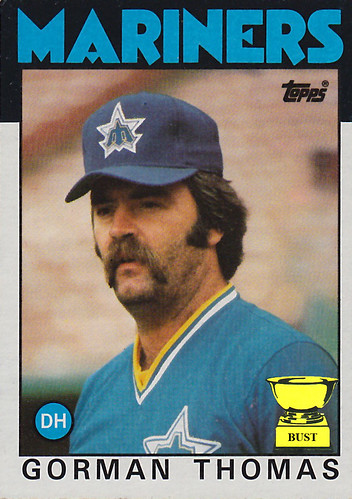
Maybe it was Goose Gossage. I don't remember.
I can't find the pictures, but I really did rock the Fu Manchu. I selected the style because I thought people took me too seriously. By that time, I started trimming the remnants of my hair pretty closely to my scalp and wearing mostly khakis and button-downs to work. As a result, I think people assumed I had no personality whatsoever and seem startled when I tried to tell a joke. Perhaps I just told bad jokes, dunno.
I did notice, however, that when I wore the Fu Manchu, my jokes got funnier. People thought I looked a little wild and dangerous. Actually, people either freaked out entirely or they were amused and found it easier to talk to me. It opened up a whole new world of conversation and social access to me.
Then my girlfriend at the time told me to shave it off, and I did.
At least I married that one.
UPDATED!
I knew it was in here somewhere

Monday, April 29, 2013
Shave #14: How razors differ from bicycles
Der wunderplastik razor continues to do its job consistently, comfortably and without fanfare.
I've written in previous posts about remarkable we should find it that manufacturers can meet a human need so inexpensively. We find ourselves so surrounded by these everyday miracles that we usually fail to recognize them. According to my man Bryan Callahan at the Bill & Melinda Gates Foundation, 40% of the world lacks access to clean water and sanitation. Yet in many parts of this country, we freak out when we have water that we have to boil before drinking, even though it flows freely from the taps.
Perhaps it's worth looking at consumer products that haven't gotten substantially cheaper, or whose cheap versions aren't any good. It really hit me this weekend: good bicycles cost more than they should.
Wal-Mart and Target sell lots of bikes for under $200. While these prices make them affordable to a wide range of Americans (or a range of wide Americans, if you want to be snide), most bike aficionados believe the bikes don't hold up very well. Generally speaking, more durable, better-made bikes come from bike shops and start around $400. They go up from there. Quite a bit.
Bike prices have lived like this, accounting for inflation, as long as I've ridden bikes. But why do decent bikes cost so much when, say, cheap watches work pretty well? My beloved $13 Casio tells time not just as well as a $6,000 Rolex, but better than it thanks to quartz accuracy. It also has a stopwatch, an alarm and day/date display.
"But wait," says the watch purist. "They're not the same thing." Exactly. Watch manufacturers worked with the direction of "give people something that tells the time reliably" and ended up with two completely different products. The Casio is made mostly of plastic with electronic innards while the Rolex features high-grade stainless-steel construction and mechanical time-telling equipment.
Go over to the bike aisle in Target and you'll see that most of the bikes there are simply cheaper versions of the bikes in bike stores. They use cheaper steel tubes for the frame and have more plastic in the components. If you wanted to, you could unscrew most of the bits from the cheap bike and put it on the good bike and vice-versa. The same swap does not apply for the Casio and the Rolex.
Sure, the Chinese and the Indians make some pretty decent cheap bikes (which sell in their home markets for a lot less than in the US), but they basically just make bikes from the early 20th century with cheap labor. The bikes don't differ radically from what's out there already.
I understand than an Israeli entrepreneur has developed a bike made out of cardboard, which starts to get at the issue I'm discussing. It uses fundamentally different materials, construction techniques and even drivetrain (an automotive fan belt replaces the chain, for instance). The inventor expects them to retail for under $30 based on a materials cost of $12.
I wonder what took someone so long?
Presumably, the economics of a good, cheap bicycle argue against its creation. That is, first-worlders have signaled an interest in $200 bikes even if they aren't very good while the developing world, which could use a good, cheap bike, probably doesn't offer appealing enough profit margins.
No wonder so many Indians grow their beards long. Schick and Gillette probably have little interest in selling a 25¢ razor.
I've written in previous posts about remarkable we should find it that manufacturers can meet a human need so inexpensively. We find ourselves so surrounded by these everyday miracles that we usually fail to recognize them. According to my man Bryan Callahan at the Bill & Melinda Gates Foundation, 40% of the world lacks access to clean water and sanitation. Yet in many parts of this country, we freak out when we have water that we have to boil before drinking, even though it flows freely from the taps.
Perhaps it's worth looking at consumer products that haven't gotten substantially cheaper, or whose cheap versions aren't any good. It really hit me this weekend: good bicycles cost more than they should.
Wal-Mart and Target sell lots of bikes for under $200. While these prices make them affordable to a wide range of Americans (or a range of wide Americans, if you want to be snide), most bike aficionados believe the bikes don't hold up very well. Generally speaking, more durable, better-made bikes come from bike shops and start around $400. They go up from there. Quite a bit.
Bike prices have lived like this, accounting for inflation, as long as I've ridden bikes. But why do decent bikes cost so much when, say, cheap watches work pretty well? My beloved $13 Casio tells time not just as well as a $6,000 Rolex, but better than it thanks to quartz accuracy. It also has a stopwatch, an alarm and day/date display.
"But wait," says the watch purist. "They're not the same thing." Exactly. Watch manufacturers worked with the direction of "give people something that tells the time reliably" and ended up with two completely different products. The Casio is made mostly of plastic with electronic innards while the Rolex features high-grade stainless-steel construction and mechanical time-telling equipment.
Go over to the bike aisle in Target and you'll see that most of the bikes there are simply cheaper versions of the bikes in bike stores. They use cheaper steel tubes for the frame and have more plastic in the components. If you wanted to, you could unscrew most of the bits from the cheap bike and put it on the good bike and vice-versa. The same swap does not apply for the Casio and the Rolex.
Sure, the Chinese and the Indians make some pretty decent cheap bikes (which sell in their home markets for a lot less than in the US), but they basically just make bikes from the early 20th century with cheap labor. The bikes don't differ radically from what's out there already.
I understand than an Israeli entrepreneur has developed a bike made out of cardboard, which starts to get at the issue I'm discussing. It uses fundamentally different materials, construction techniques and even drivetrain (an automotive fan belt replaces the chain, for instance). The inventor expects them to retail for under $30 based on a materials cost of $12.
I wonder what took someone so long?
Presumably, the economics of a good, cheap bicycle argue against its creation. That is, first-worlders have signaled an interest in $200 bikes even if they aren't very good while the developing world, which could use a good, cheap bike, probably doesn't offer appealing enough profit margins.
No wonder so many Indians grow their beards long. Schick and Gillette probably have little interest in selling a 25¢ razor.
Friday, April 26, 2013
Shave #13: Improves with Age
After nearly three weeks into the Cheap Razor Experiment, I believe that the plastic wonder has actually improved as a shaver. Today's shave, after a day off, seemed smoother than the last one. I'd like to believe that my chiseled features have actually sharpened the razor, but I'd also like to believe that Sofia Vergara would instantly fall under my spell if she ever met me.
This all makes me wonder what kind of testing Schick and Gillette do on their razors. In TV commercials, they like to depict torture tests, but those tests only happen after a razor has become a finalized product.
Years ago, a former researcher at Procter & Gamble told me that they used to pay people to take showers while being watched. I think the test subjects wore bathing suits and, of course, the researchers cared how they used soap and shampoo. Still, it probably beats sitting in a dark room behind a two-way mirror and eating M&Ms.
I also learned that packaged goods company employees know lots of little secrets. For instance, a former brand manager in laundry care told me that powdered detergent actually cleans better than liquid (which I don't take advantage of) and that dryer sheets can be re-used many times (which I do).
I'd like to believe that somewhere, in the vaults beneath Gillette's or Schick's office lies a room like the one at the end of "Raiders of the Lost Ark" where they store reams of secrets about razors.

Then again, there's that Sofia Vergara thing.
This all makes me wonder what kind of testing Schick and Gillette do on their razors. In TV commercials, they like to depict torture tests, but those tests only happen after a razor has become a finalized product.
Razor test or beefcake? You decide.
Years ago, a former researcher at Procter & Gamble told me that they used to pay people to take showers while being watched. I think the test subjects wore bathing suits and, of course, the researchers cared how they used soap and shampoo. Still, it probably beats sitting in a dark room behind a two-way mirror and eating M&Ms.
I also learned that packaged goods company employees know lots of little secrets. For instance, a former brand manager in laundry care told me that powdered detergent actually cleans better than liquid (which I don't take advantage of) and that dryer sheets can be re-used many times (which I do).
I'd like to believe that somewhere, in the vaults beneath Gillette's or Schick's office lies a room like the one at the end of "Raiders of the Lost Ark" where they store reams of secrets about razors.
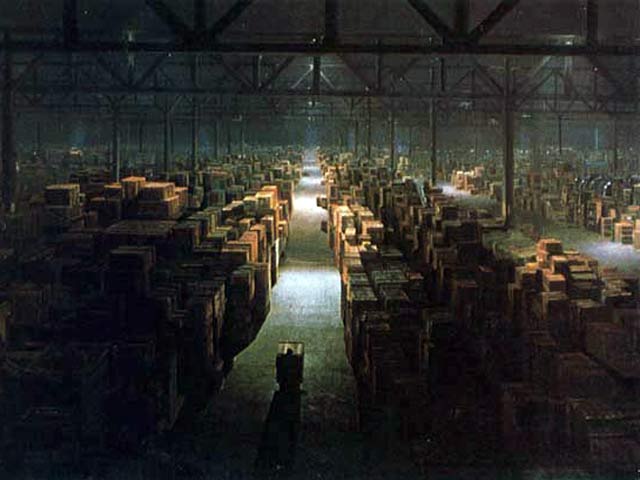
The steel in the blades comes from recycled mental hospital shackles. Tell no one!
Wednesday, April 24, 2013
Shave #12: The Face of Rebellion
Nothing feels quite so rebellious to me as not shaving on a weekday.
Jay Chiat, the founder of Chiat/Day advertising (you know, these guys) used to say that he went into advertising because he wanted to wear sneakers to work. Maybe he just said that because his agency had the Nike account at various times, but he hit on a certain truth. Namely, that men signal a certain sort of defiance by dressing down.
Similarly, not shaving sends a signal. So when I decided not to shave yesterday, I felt that I had somehow bent the rules. Granted, I had no client-facing business yesterday; had I needed to meet a client, I would have spent that extra four minutes in the bathroom. For that matter, lots of ad agency gents will cultivate a day's growth of beard.
On the contrary, I generally don't shave when I have to go into the office on a weekend. So maybe it's not a sign of defiance, per se, but a sign that if you see stubble, you're on my time, not yours.
Jay Chiat, the founder of Chiat/Day advertising (you know, these guys) used to say that he went into advertising because he wanted to wear sneakers to work. Maybe he just said that because his agency had the Nike account at various times, but he hit on a certain truth. Namely, that men signal a certain sort of defiance by dressing down.
Similarly, not shaving sends a signal. So when I decided not to shave yesterday, I felt that I had somehow bent the rules. Granted, I had no client-facing business yesterday; had I needed to meet a client, I would have spent that extra four minutes in the bathroom. For that matter, lots of ad agency gents will cultivate a day's growth of beard.
On the contrary, I generally don't shave when I have to go into the office on a weekend. So maybe it's not a sign of defiance, per se, but a sign that if you see stubble, you're on my time, not yours.
Monday, April 22, 2013
Shave #11: Trouble in Paradise
The third Monday shave proved to test the limits of my reuse-until-my-face-bleeds experiment. I could definitely feel the razor dragging a bit. This experiment may have a shorter lifespan than I had intended.
The more I think about it, however, the more I recall what shaving used to be like for me. I switched to the Mach3 maybe 15 years ago. Before that, I used the Gillette Atra, which consisted of a pivoting head and two--count 'em two--blades. I remember that I had to use after-shave balm of some kind (conveniently also produced by Gillette) because my face felt like fire after I shaved. Every time.
And that's what we accepted. So a blade that I've now used for two weeks still feels better than a brand-new blade from 15 years ago.
The upward spiral of consumer experience does not break new ground in the blogosphere, much less in the province of the written word. We've all seen Facebook posts that tell us how today's college freshman never rode to school on a dinosaur or made fire by striking flint on steel, or what have you. However, humble implements such as razors never make that list.
They should, however.
I remember that a Pakistani cab driver once told me not to complain about cheap Chinese consumer products. In other countries, they have a whole other level of cheap Chinese consumer products. He mentioned steam irons, for instance. The steam iron you buy at Wal-Mart in America works as you expect it to work. Nothing exciting, of course, but it works.
In Pakistan and other countries, they routinely get irons and other simple products that work for a month and then die. I can't imagine a steam iron that simply doesn't work. However, that kind of product evidently exists elsewhere.
So let us continue to celebrate the humble Schick Quattro and its unassuming competence.
The more I think about it, however, the more I recall what shaving used to be like for me. I switched to the Mach3 maybe 15 years ago. Before that, I used the Gillette Atra, which consisted of a pivoting head and two--count 'em two--blades. I remember that I had to use after-shave balm of some kind (conveniently also produced by Gillette) because my face felt like fire after I shaved. Every time.
And that's what we accepted. So a blade that I've now used for two weeks still feels better than a brand-new blade from 15 years ago.
The upward spiral of consumer experience does not break new ground in the blogosphere, much less in the province of the written word. We've all seen Facebook posts that tell us how today's college freshman never rode to school on a dinosaur or made fire by striking flint on steel, or what have you. However, humble implements such as razors never make that list.
They should, however.
I remember that a Pakistani cab driver once told me not to complain about cheap Chinese consumer products. In other countries, they have a whole other level of cheap Chinese consumer products. He mentioned steam irons, for instance. The steam iron you buy at Wal-Mart in America works as you expect it to work. Nothing exciting, of course, but it works.
In Pakistan and other countries, they routinely get irons and other simple products that work for a month and then die. I can't imagine a steam iron that simply doesn't work. However, that kind of product evidently exists elsewhere.
So let us continue to celebrate the humble Schick Quattro and its unassuming competence.
Wednesday, April 17, 2013
Shave #8: Shaving Yourself in a Corner
Eight shaves on the cheap disposable razor and I've seen no decrease in shaving quality.
In some ways, razor manufacturers have created their own problem. Yes, many if not most men change their blades/cartridges/disposables more frequently than I plan to do. However, I suspect that they pour no end of money into their advertising to encourage men (or the women who buy their shaving supplies) to buy more often than they need to.
It reminds me of one of the first website development projects I worked on ages ago. Gillette, then an independent company, hired my employer to help them develop an ecommerce site. Specifically, they wanted to sell blades, Braun shavers (which they owned), Oral-B toothbrushes (ditto) and Duracell batteries (ditto).
They faced a considerable challenge: because they sold most of their product through mass marketers and supermarkets, they couldn't offer a lower price than retail. They feared that, say, Wal-Mart might stop stocking their products if Gillette sold them at a discount directly.
Instead, they wanted to trade on convenience and selection. They reasoned that buying online would allow consumers to free up their time to do other things. Or that they could schedule monthly shipments of blades, batteries, brushes and so on. Or that they could find the menthol-scented, sensitive-skin, extraplusdoublegood version of the product they used.
My clients needed a few rounds of focus groups to reveal the trap that they had set for themselves: they had trained the customer too well.
Walk into any mass retailer or supermarket. More specifically, walk over to the checkout line. What do you see? Chances are, batteries and razor blades. You'll also see entire store aisles dedicated to shaving products and batteries, with more stock-keeping units (SKUs, or types of products) than most people will ever need. You'll also see battery displays near just about any battery-powered device sold in the store. In short, Gillette simply couldn't make the purchase of their products any more convenient.
I don't have anything to add to this tale, except maybe that sometimes it helps to ask if a problem your organization is facing really is a problem after all.
In some ways, razor manufacturers have created their own problem. Yes, many if not most men change their blades/cartridges/disposables more frequently than I plan to do. However, I suspect that they pour no end of money into their advertising to encourage men (or the women who buy their shaving supplies) to buy more often than they need to.
It reminds me of one of the first website development projects I worked on ages ago. Gillette, then an independent company, hired my employer to help them develop an ecommerce site. Specifically, they wanted to sell blades, Braun shavers (which they owned), Oral-B toothbrushes (ditto) and Duracell batteries (ditto).
They faced a considerable challenge: because they sold most of their product through mass marketers and supermarkets, they couldn't offer a lower price than retail. They feared that, say, Wal-Mart might stop stocking their products if Gillette sold them at a discount directly.
Instead, they wanted to trade on convenience and selection. They reasoned that buying online would allow consumers to free up their time to do other things. Or that they could schedule monthly shipments of blades, batteries, brushes and so on. Or that they could find the menthol-scented, sensitive-skin, extraplusdoublegood version of the product they used.
My clients needed a few rounds of focus groups to reveal the trap that they had set for themselves: they had trained the customer too well.
Walk into any mass retailer or supermarket. More specifically, walk over to the checkout line. What do you see? Chances are, batteries and razor blades. You'll also see entire store aisles dedicated to shaving products and batteries, with more stock-keeping units (SKUs, or types of products) than most people will ever need. You'll also see battery displays near just about any battery-powered device sold in the store. In short, Gillette simply couldn't make the purchase of their products any more convenient.
I don't have anything to add to this tale, except maybe that sometimes it helps to ask if a problem your organization is facing really is a problem after all.
Tuesday, April 16, 2013
Shave #7: Making Yourself Write
In part, I've decided to write about my day-to-day experience with a disposable razor to force myself to write every day, or at least every day that I shave. Strangely, I find it harder to write every day than to shave every day. I say "strangely" because I learned to write a good decade before I needed to shave, so you would think I'd have an easier time of writing.
Not so.
Writing, of course, requires much more mental effort than shaving. I don't simply write starting at my left ear and work my way across to my right. Hmmmm...actually, I do start on the left and work my way to the right, as does the writer of any language based on the Roman alphabet.
More accurately, I don't have to think to make myself shave. It's something I do in between brushing my teeth and getting dressed. To write this blog, for instance, I have to remember to take a moment among the meetings and phone calls and real work. Then I have to think of a subject.
I suspect that it will get easier to write over time. As I recall, those first few shaves seemed like torture.
So ask me again in a few months...or when I grow a beard.
Not so.
Writing, of course, requires much more mental effort than shaving. I don't simply write starting at my left ear and work my way across to my right. Hmmmm...actually, I do start on the left and work my way to the right, as does the writer of any language based on the Roman alphabet.
More accurately, I don't have to think to make myself shave. It's something I do in between brushing my teeth and getting dressed. To write this blog, for instance, I have to remember to take a moment among the meetings and phone calls and real work. Then I have to think of a subject.
I suspect that it will get easier to write over time. As I recall, those first few shaves seemed like torture.
So ask me again in a few months...or when I grow a beard.
Subscribe to:
Posts (Atom)