Der wunderplastik razor continues to do its job consistently, comfortably and without fanfare.
I've written in previous posts about remarkable we should find it that manufacturers can meet a human need so inexpensively. We find ourselves so surrounded by these everyday miracles that we usually fail to recognize them. According to my man Bryan Callahan at the Bill & Melinda Gates Foundation, 40% of the world lacks access to clean water and sanitation. Yet in many parts of this country, we freak out when we have water that we have to boil before drinking, even though it flows freely from the taps.
Perhaps it's worth looking at consumer products that haven't gotten substantially cheaper, or whose cheap versions aren't any good. It really hit me this weekend: good bicycles cost more than they should.
Wal-Mart and Target sell lots of bikes for under $200. While these prices make them affordable to a wide range of Americans (or a range of wide Americans, if you want to be snide), most bike aficionados believe the bikes don't hold up very well. Generally speaking, more durable, better-made bikes come from bike shops and start around $400. They go up from there. Quite a bit.
Bike prices have lived like this, accounting for inflation, as long as I've ridden bikes. But why do decent bikes cost so much when, say, cheap watches work pretty well? My beloved $13 Casio tells time not just as well as a $6,000 Rolex, but better than it thanks to quartz accuracy. It also has a stopwatch, an alarm and day/date display.
"But wait," says the watch purist. "They're not the same thing." Exactly. Watch manufacturers worked with the direction of "give people something that tells the time reliably" and ended up with two completely different products. The Casio is made mostly of plastic with electronic innards while the Rolex features high-grade stainless-steel construction and mechanical time-telling equipment.
Go over to the bike aisle in Target and you'll see that most of the bikes there are simply cheaper versions of the bikes in bike stores. They use cheaper steel tubes for the frame and have more plastic in the components. If you wanted to, you could unscrew most of the bits from the cheap bike and put it on the good bike and vice-versa. The same swap does not apply for the Casio and the Rolex.
Sure, the Chinese and the Indians make some pretty decent cheap bikes (which sell in their home markets for a lot less than in the US), but they basically just make bikes from the early 20th century with cheap labor. The bikes don't differ radically from what's out there already.
I understand than an Israeli entrepreneur has developed a bike made out of cardboard, which starts to get at the issue I'm discussing. It uses fundamentally different materials, construction techniques and even drivetrain (an automotive fan belt replaces the chain, for instance). The inventor expects them to retail for under $30 based on a materials cost of $12.
I wonder what took someone so long?
Presumably, the economics of a good, cheap bicycle argue against its creation. That is, first-worlders have signaled an interest in $200 bikes even if they aren't very good while the developing world, which could use a good, cheap bike, probably doesn't offer appealing enough profit margins.
No wonder so many Indians grow their beards long. Schick and Gillette probably have little interest in selling a 25¢ razor.
Monday, April 29, 2013

Friday, April 26, 2013
Shave #13: Improves with Age
After nearly three weeks into the Cheap Razor Experiment, I believe that the plastic wonder has actually improved as a shaver. Today's shave, after a day off, seemed smoother than the last one. I'd like to believe that my chiseled features have actually sharpened the razor, but I'd also like to believe that Sofia Vergara would instantly fall under my spell if she ever met me.
This all makes me wonder what kind of testing Schick and Gillette do on their razors. In TV commercials, they like to depict torture tests, but those tests only happen after a razor has become a finalized product.
Years ago, a former researcher at Procter & Gamble told me that they used to pay people to take showers while being watched. I think the test subjects wore bathing suits and, of course, the researchers cared how they used soap and shampoo. Still, it probably beats sitting in a dark room behind a two-way mirror and eating M&Ms.
I also learned that packaged goods company employees know lots of little secrets. For instance, a former brand manager in laundry care told me that powdered detergent actually cleans better than liquid (which I don't take advantage of) and that dryer sheets can be re-used many times (which I do).
I'd like to believe that somewhere, in the vaults beneath Gillette's or Schick's office lies a room like the one at the end of "Raiders of the Lost Ark" where they store reams of secrets about razors.

Then again, there's that Sofia Vergara thing.
This all makes me wonder what kind of testing Schick and Gillette do on their razors. In TV commercials, they like to depict torture tests, but those tests only happen after a razor has become a finalized product.
Razor test or beefcake? You decide.
Years ago, a former researcher at Procter & Gamble told me that they used to pay people to take showers while being watched. I think the test subjects wore bathing suits and, of course, the researchers cared how they used soap and shampoo. Still, it probably beats sitting in a dark room behind a two-way mirror and eating M&Ms.
I also learned that packaged goods company employees know lots of little secrets. For instance, a former brand manager in laundry care told me that powdered detergent actually cleans better than liquid (which I don't take advantage of) and that dryer sheets can be re-used many times (which I do).
I'd like to believe that somewhere, in the vaults beneath Gillette's or Schick's office lies a room like the one at the end of "Raiders of the Lost Ark" where they store reams of secrets about razors.
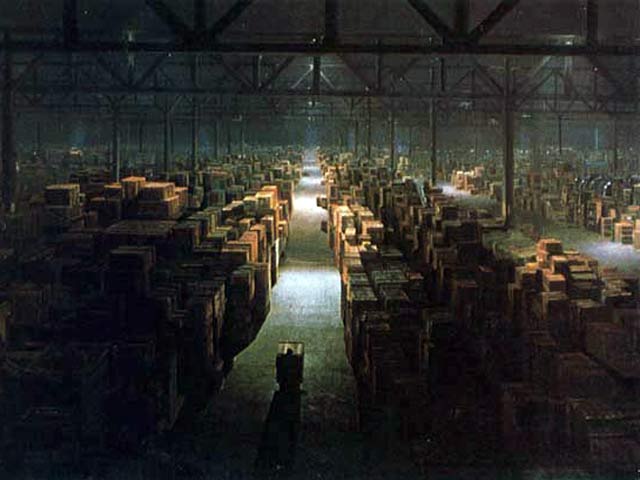
The steel in the blades comes from recycled mental hospital shackles. Tell no one!
Wednesday, April 24, 2013
Shave #12: The Face of Rebellion
Nothing feels quite so rebellious to me as not shaving on a weekday.
Jay Chiat, the founder of Chiat/Day advertising (you know, these guys) used to say that he went into advertising because he wanted to wear sneakers to work. Maybe he just said that because his agency had the Nike account at various times, but he hit on a certain truth. Namely, that men signal a certain sort of defiance by dressing down.
Similarly, not shaving sends a signal. So when I decided not to shave yesterday, I felt that I had somehow bent the rules. Granted, I had no client-facing business yesterday; had I needed to meet a client, I would have spent that extra four minutes in the bathroom. For that matter, lots of ad agency gents will cultivate a day's growth of beard.
On the contrary, I generally don't shave when I have to go into the office on a weekend. So maybe it's not a sign of defiance, per se, but a sign that if you see stubble, you're on my time, not yours.
Jay Chiat, the founder of Chiat/Day advertising (you know, these guys) used to say that he went into advertising because he wanted to wear sneakers to work. Maybe he just said that because his agency had the Nike account at various times, but he hit on a certain truth. Namely, that men signal a certain sort of defiance by dressing down.
Similarly, not shaving sends a signal. So when I decided not to shave yesterday, I felt that I had somehow bent the rules. Granted, I had no client-facing business yesterday; had I needed to meet a client, I would have spent that extra four minutes in the bathroom. For that matter, lots of ad agency gents will cultivate a day's growth of beard.
On the contrary, I generally don't shave when I have to go into the office on a weekend. So maybe it's not a sign of defiance, per se, but a sign that if you see stubble, you're on my time, not yours.
Monday, April 22, 2013
Shave #11: Trouble in Paradise
The third Monday shave proved to test the limits of my reuse-until-my-face-bleeds experiment. I could definitely feel the razor dragging a bit. This experiment may have a shorter lifespan than I had intended.
The more I think about it, however, the more I recall what shaving used to be like for me. I switched to the Mach3 maybe 15 years ago. Before that, I used the Gillette Atra, which consisted of a pivoting head and two--count 'em two--blades. I remember that I had to use after-shave balm of some kind (conveniently also produced by Gillette) because my face felt like fire after I shaved. Every time.
And that's what we accepted. So a blade that I've now used for two weeks still feels better than a brand-new blade from 15 years ago.
The upward spiral of consumer experience does not break new ground in the blogosphere, much less in the province of the written word. We've all seen Facebook posts that tell us how today's college freshman never rode to school on a dinosaur or made fire by striking flint on steel, or what have you. However, humble implements such as razors never make that list.
They should, however.
I remember that a Pakistani cab driver once told me not to complain about cheap Chinese consumer products. In other countries, they have a whole other level of cheap Chinese consumer products. He mentioned steam irons, for instance. The steam iron you buy at Wal-Mart in America works as you expect it to work. Nothing exciting, of course, but it works.
In Pakistan and other countries, they routinely get irons and other simple products that work for a month and then die. I can't imagine a steam iron that simply doesn't work. However, that kind of product evidently exists elsewhere.
So let us continue to celebrate the humble Schick Quattro and its unassuming competence.
The more I think about it, however, the more I recall what shaving used to be like for me. I switched to the Mach3 maybe 15 years ago. Before that, I used the Gillette Atra, which consisted of a pivoting head and two--count 'em two--blades. I remember that I had to use after-shave balm of some kind (conveniently also produced by Gillette) because my face felt like fire after I shaved. Every time.
And that's what we accepted. So a blade that I've now used for two weeks still feels better than a brand-new blade from 15 years ago.
The upward spiral of consumer experience does not break new ground in the blogosphere, much less in the province of the written word. We've all seen Facebook posts that tell us how today's college freshman never rode to school on a dinosaur or made fire by striking flint on steel, or what have you. However, humble implements such as razors never make that list.
They should, however.
I remember that a Pakistani cab driver once told me not to complain about cheap Chinese consumer products. In other countries, they have a whole other level of cheap Chinese consumer products. He mentioned steam irons, for instance. The steam iron you buy at Wal-Mart in America works as you expect it to work. Nothing exciting, of course, but it works.
In Pakistan and other countries, they routinely get irons and other simple products that work for a month and then die. I can't imagine a steam iron that simply doesn't work. However, that kind of product evidently exists elsewhere.
So let us continue to celebrate the humble Schick Quattro and its unassuming competence.
Wednesday, April 17, 2013
Shave #8: Shaving Yourself in a Corner
Eight shaves on the cheap disposable razor and I've seen no decrease in shaving quality.
In some ways, razor manufacturers have created their own problem. Yes, many if not most men change their blades/cartridges/disposables more frequently than I plan to do. However, I suspect that they pour no end of money into their advertising to encourage men (or the women who buy their shaving supplies) to buy more often than they need to.
It reminds me of one of the first website development projects I worked on ages ago. Gillette, then an independent company, hired my employer to help them develop an ecommerce site. Specifically, they wanted to sell blades, Braun shavers (which they owned), Oral-B toothbrushes (ditto) and Duracell batteries (ditto).
They faced a considerable challenge: because they sold most of their product through mass marketers and supermarkets, they couldn't offer a lower price than retail. They feared that, say, Wal-Mart might stop stocking their products if Gillette sold them at a discount directly.
Instead, they wanted to trade on convenience and selection. They reasoned that buying online would allow consumers to free up their time to do other things. Or that they could schedule monthly shipments of blades, batteries, brushes and so on. Or that they could find the menthol-scented, sensitive-skin, extraplusdoublegood version of the product they used.
My clients needed a few rounds of focus groups to reveal the trap that they had set for themselves: they had trained the customer too well.
Walk into any mass retailer or supermarket. More specifically, walk over to the checkout line. What do you see? Chances are, batteries and razor blades. You'll also see entire store aisles dedicated to shaving products and batteries, with more stock-keeping units (SKUs, or types of products) than most people will ever need. You'll also see battery displays near just about any battery-powered device sold in the store. In short, Gillette simply couldn't make the purchase of their products any more convenient.
I don't have anything to add to this tale, except maybe that sometimes it helps to ask if a problem your organization is facing really is a problem after all.
In some ways, razor manufacturers have created their own problem. Yes, many if not most men change their blades/cartridges/disposables more frequently than I plan to do. However, I suspect that they pour no end of money into their advertising to encourage men (or the women who buy their shaving supplies) to buy more often than they need to.
It reminds me of one of the first website development projects I worked on ages ago. Gillette, then an independent company, hired my employer to help them develop an ecommerce site. Specifically, they wanted to sell blades, Braun shavers (which they owned), Oral-B toothbrushes (ditto) and Duracell batteries (ditto).
They faced a considerable challenge: because they sold most of their product through mass marketers and supermarkets, they couldn't offer a lower price than retail. They feared that, say, Wal-Mart might stop stocking their products if Gillette sold them at a discount directly.
Instead, they wanted to trade on convenience and selection. They reasoned that buying online would allow consumers to free up their time to do other things. Or that they could schedule monthly shipments of blades, batteries, brushes and so on. Or that they could find the menthol-scented, sensitive-skin, extraplusdoublegood version of the product they used.
My clients needed a few rounds of focus groups to reveal the trap that they had set for themselves: they had trained the customer too well.
Walk into any mass retailer or supermarket. More specifically, walk over to the checkout line. What do you see? Chances are, batteries and razor blades. You'll also see entire store aisles dedicated to shaving products and batteries, with more stock-keeping units (SKUs, or types of products) than most people will ever need. You'll also see battery displays near just about any battery-powered device sold in the store. In short, Gillette simply couldn't make the purchase of their products any more convenient.
I don't have anything to add to this tale, except maybe that sometimes it helps to ask if a problem your organization is facing really is a problem after all.
Tuesday, April 16, 2013
Shave #7: Making Yourself Write
In part, I've decided to write about my day-to-day experience with a disposable razor to force myself to write every day, or at least every day that I shave. Strangely, I find it harder to write every day than to shave every day. I say "strangely" because I learned to write a good decade before I needed to shave, so you would think I'd have an easier time of writing.
Not so.
Writing, of course, requires much more mental effort than shaving. I don't simply write starting at my left ear and work my way across to my right. Hmmmm...actually, I do start on the left and work my way to the right, as does the writer of any language based on the Roman alphabet.
More accurately, I don't have to think to make myself shave. It's something I do in between brushing my teeth and getting dressed. To write this blog, for instance, I have to remember to take a moment among the meetings and phone calls and real work. Then I have to think of a subject.
I suspect that it will get easier to write over time. As I recall, those first few shaves seemed like torture.
So ask me again in a few months...or when I grow a beard.
Not so.
Writing, of course, requires much more mental effort than shaving. I don't simply write starting at my left ear and work my way across to my right. Hmmmm...actually, I do start on the left and work my way to the right, as does the writer of any language based on the Roman alphabet.
More accurately, I don't have to think to make myself shave. It's something I do in between brushing my teeth and getting dressed. To write this blog, for instance, I have to remember to take a moment among the meetings and phone calls and real work. Then I have to think of a subject.
I suspect that it will get easier to write over time. As I recall, those first few shaves seemed like torture.
So ask me again in a few months...or when I grow a beard.
Monday, April 15, 2013
Shave #6: Isn't it odd?
My second Monday shave (I don't shave on weekends) went better than the first. My cheapo razor felt smooth and sure.
Over the weekend, I watched Louis C.K.'s HBO comedy special, which I loved. If you don't know him, Louis specializes in skewing perspective. His most famous bit, for example, transforms cell phone signals from an expectation into a blessed miracle (apologies for quality):
I've always thought that we take an easy shave for granted as well. I mean, you're barely awake and you're flinging a piece of steel that's literally razor-sharp all around your nose, mouth and throat. Yet you never read an obit with the line "the deceased was found in his bathroom with his throat slit and a can of Foamy in his hand."
Think of all the dangerous things that you do and then think about how far from waking up you do them. Most people, for instance, shower, dress and even have a cup of coffee before operating a motor vehicle. No one hops out of bed and says "let's fire up the table saw!" Yet here we stand, most mornings, ready to slice away whatever falls in the path of our razors.
Amazing.
Over the weekend, I watched Louis C.K.'s HBO comedy special, which I loved. If you don't know him, Louis specializes in skewing perspective. His most famous bit, for example, transforms cell phone signals from an expectation into a blessed miracle (apologies for quality):
I've always thought that we take an easy shave for granted as well. I mean, you're barely awake and you're flinging a piece of steel that's literally razor-sharp all around your nose, mouth and throat. Yet you never read an obit with the line "the deceased was found in his bathroom with his throat slit and a can of Foamy in his hand."
Think of all the dangerous things that you do and then think about how far from waking up you do them. Most people, for instance, shower, dress and even have a cup of coffee before operating a motor vehicle. No one hops out of bed and says "let's fire up the table saw!" Yet here we stand, most mornings, ready to slice away whatever falls in the path of our razors.
Amazing.
Subscribe to:
Posts (Atom)